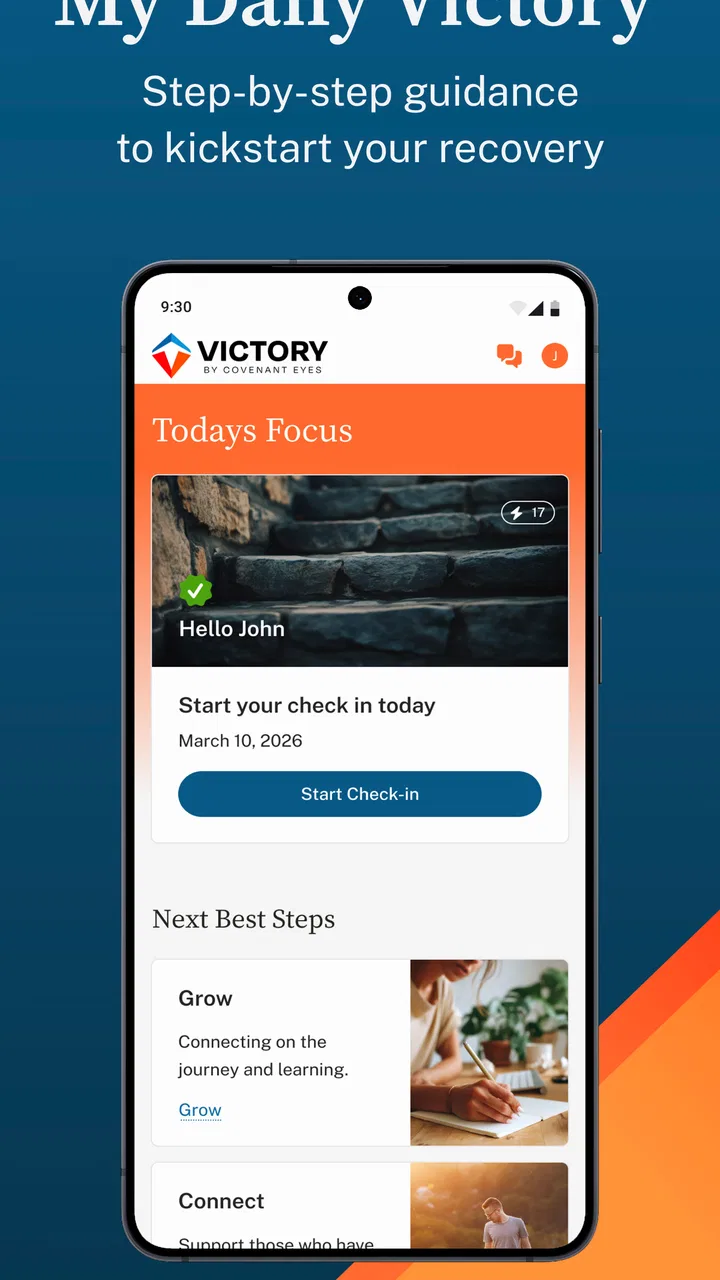
Victory by Covenant Eyes
- 4.6
- Rating
- 100.00K
- Installs
- Free
- Price

 Analysis by App-foxy
Changing a private habit is rarely solved by installing one more app and hoping motivation does the rest. What I found useful about Victory by Covenant Eyes is that it treats quitting pornography as an ongoing personal process rather than a quick challenge with a finish line. It is a free lifestyle app from Covenant Eyes, aimed both at people working on their own behavior and at those who want to support a friend.
I would describe it as a guided support tool, not a replacement for therapy, a crisis service, or a complete device-control system. Its value comes from giving a difficult goal some structure: you can return to it, reflect on what is happening, and build repeatable habits around moments when your resolve is weakest. That makes it more useful than a motivational quote app, although it also means the results depend heavily on whether you are willing to engage honestly.
How I used Victory as a daily support routine
My most practical approach was to avoid treating the app as something I opened only after a setback. Instead, I used it as a short check-in point at predictable times. A morning review helped me remember the reason behind the goal, while an evening check made it easier to notice patterns such as boredom, isolation, stress, or late-night phone use. The important change was turning the app into part of a routine rather than an emergency button.
You May Also Like

 Pandora - Music & Podcasts
Pandora’s Music Is Easy to Start, but Harder to Recover
Pandora’s strength is its low-effort path from a seed to a station. Its weak spot is how much confidence it asks you to place in connection, setup, and quiet recovery.

 AccuWeather: Weather Radar
AccuWeather Review: A Quick, Clear Forecast for Everyday Decisions
For everyday plans, the best forecast is the one you can understand quickly. AccuWeather makes rain timing, radar, and local conditions easy to act on, with a few trade-offs.

 Hill Climb Racing
Why Hill Climb Racing Still Turns Crashes Into One More Run
A tiny car, a bumpy hill and one more upgrade: Hill Climb Racing keeps resurfacing because its simple chaos makes every near-miss feel personal.

 AliExpress - Shopping App
AliExpress Makes Global Shopping Feel Personal, but Shoppers Bear the Risk
AliExpress turns a global marketplace into a pocket-sized discovery engine. Its reach is useful, its shopping loop compelling, and its trade-offs easy to miss.

 Lords Mobile: Kingdom Wars
Lords Mobile Is a Kingdom-Building Routine, Not a Quick Match
A case-by-case verdict on the building, battles, device demands, and social commitments that make Lords Mobile rewarding for some players and exhausting for others.

 PDF Scanner app - TapScanner
TapScanner Makes Paperwork Easier to Capture, Check, and Share
TapScanner makes scanning with a phone feel less like a rescue operation and more like a dependable step in getting work done. Its capture tools are useful, though not flawless.
More From Our News Desk
View All News


The app’s central promise is straightforward: quit pornography for good or help a friend. That wording points to two different workflows. If you are using it personally, the focus is self-awareness and persistence. If you are supporting someone else, the challenge is different: encouragement must not become surveillance, nagging, or a substitute for trust. I found that the second use case requires more care than the store summary suggests.
A realistic everyday scenario is a person who finishes work, feels mentally drained, and reaches for a phone without a clear plan. In that situation, opening a support app after the urge has already become intense may be too late. A better pattern is to check in before the vulnerable period, decide what the next hour will look like, and keep an alternative activity ready. Victory can serve as the reminder and reflection point, but the actual protection comes from the surrounding routine.
I also recommend deciding in advance what you will do after a slip. Without that plan, people often turn one mistake into several hours of shame and avoidance. A useful response is to record what happened as honestly as possible, identify the trigger, and restart the next decision rather than waiting for a perfect new day. The app is most helpful when it supports that reset instead of becoming a scorecard used for self-punishment.
For someone helping a friend, the baseline workflow should be agreed together. Ask what kind of support is welcome, how often to check in, and what language feels encouraging rather than judgmental. A short message such as “How are you doing with the plan we discussed?” is usually more constructive than demanding a report. The app can create a shared reason to talk, but the relationship still needs boundaries.
What to decide before you begin
Before relying on the app, I would write down the personal reason for changing. “I should stop” is vague and easy to dismiss during a difficult moment. A more useful reason might involve a relationship, concentration, faith, self-respect, or wanting greater control over attention. The reason does not need to be dramatic; it needs to be specific enough to matter when convenience takes over.
I would also identify the situations that repeatedly lead to the behavior. Common examples include being alone with a phone in bed, feeling rejected, procrastinating on a difficult task, or using private browsing as an escape from anxiety. The point is not to label yourself. It is to recognize the chain early enough to interrupt it.
One non-obvious lesson is that the first useful intervention may happen several minutes before the urge. If the pattern begins with scrolling aimlessly, staying in a room after everyone else has gone to sleep, or avoiding an uncomfortable task, then the best use of Victory is as part of an earlier checkpoint. Waiting until the final moment places too much pressure on willpower.
Settings and expectations worth checking
When I set up a habit-focused app, I prefer to check every available option calmly rather than accepting a default routine automatically. In Victory, that means making sure the way you intend to use personal support and the way you intend to involve a friend are clearly separated in your own plan. Confusion at the beginning can create unnecessary friction later.
I would pay particular attention to notification behavior. A reminder can be useful before a predictable risk period, but the same reminder can become background noise if it arrives at random times or too often. The best schedule is connected to your actual day: perhaps after work, before bed, or during another transition when you usually lose focus. If a reminder feels accusatory, change your relationship with it; it should prompt a choice, not deliver a verdict.
Privacy is another area where I would slow down. This is a sensitive subject, and you should understand what you are comfortable sharing with another person before inviting them into your process. Do not add a friend merely because the idea sounds responsible. Choose someone who can keep confidence, listen without humiliating you, and respect the limits you set together.
The age rating is Everyone, but that should not be mistaken for a promise that every family situation is automatically simple. A younger user may need a trusted adult to help explain the goal in a healthy, non-shaming way. Adults should also remember that a general lifestyle app cannot settle questions about consent, trauma, compulsive behavior, or mental health on its own.
There is a practical cost consideration as well. The app is free to start, while in-app purchases range from $0.99 to $899.99 per item. I would not make a payment simply because I felt guilty after a setback. First decide what you actually need, review the purchase screen carefully, and consider whether the paid option adds enough value to your routine. A costly commitment is not automatically a stronger commitment.
Faster patterns that make the routine easier
Experienced users usually do not depend on long sessions. They reduce the number of decisions required at vulnerable times. I found three habits especially useful: keep the check-in connected to an existing daily action, prepare a response for the first sign of temptation, and use a short reflection after a difficult moment rather than attempting a full analysis every time.
For example, you might open Victory after brushing your teeth, before starting a commute, or immediately after putting your phone on charge. Linking the app to an existing action is more reliable than waiting for inspiration. The exact trigger matters less than its consistency. If your schedule changes, move the trigger with it instead of abandoning the routine.
A second efficient pattern is the “pause before choice” rule. When you notice the familiar urge, do not negotiate with yourself while continuing the same activity. Stand up, move to a different room, put physical distance between yourself and the device, and then use the app as a brief reminder of the plan. This works because it changes the environment before the mind has built a persuasive excuse.
A third pattern is to keep reflections concrete. Rather than writing “bad day,” note the situation, emotion, device, time of day, and what happened immediately beforehand. You are looking for repeatable clues. If the same combination appears several times, change that part of the routine first. This is a more useful application of self-tracking than simply counting successful days.
For a supporter, speed matters too. A friend may not want a long conversation every day. A consistent, low-pressure check-in can work better: one question, one honest answer, and no interrogation. If the person reports a setback, ask what would make the next few hours safer instead of demanding an explanation. The app can keep the connection active, but the human response determines whether that connection feels helpful.
Shortcuts in this context are not secret buttons or advanced technical tricks. They are prepared decisions. Keep a list of alternative actions nearby, decide where the phone will stay overnight, and know whom you can contact when the usual strategy fails. These small arrangements often matter more than opening the app repeatedly.
Where Victory is strong, and where it reaches its limits
The strongest part of Victory is its focus. It is not trying to be a general meditation library, a broad productivity planner, or a social feed. Its purpose is clear, which makes it easier to connect the app with an intentional behavior-change plan. I also appreciate that it recognizes the value of helping a friend, because isolation can make this particular goal harder to sustain.
Its main limitation is equally clear: an app cannot remove every trigger from your life or make a decision for you. If your problem involves severe compulsive behavior, depression, anxiety, trauma, relationship conflict, or thoughts of self-harm, relying on Victory alone would be the wrong level of support. A qualified therapist, doctor, crisis resource, or trusted professional may be more appropriate, depending on the situation.
I would also skip it if you want a purely technical blocker that prevents access automatically across every device. Victory’s identity is centered on quitting and supporting, not on promising that a setting will solve the problem without your participation. Someone looking for strict filtering, device administration, or family controls may need a different category of tool, used carefully and with informed consent.
Compared with a paper journal, the app is easier to keep with you and may make a support routine feel more deliberate. A journal, however, gives you complete control over wording and privacy, and it does not depend on remembering to open an app. Compared with a generic habit tracker, Victory is more specific to this goal, while a general tracker may be better for someone who wants one place for exercise, sleep, study, and many unrelated habits.
Compared with counseling, it is more accessible for a quick daily check-in but far less capable of understanding the personal history behind the behavior. Compared with a friend-only arrangement, it offers a repeatable structure, but friendship provides empathy and context that software cannot reproduce. In my view, Victory works best between those options: as a practical layer that supports a personal plan and makes conversations easier to continue.
Another trade-off is emotional tone. Some users will appreciate a direct focus on quitting; others may feel that a strict goal creates shame when they do not meet it perfectly. If you notice yourself hiding activity, obsessing over a streak, or avoiding the app after a mistake, change the routine. The goal is healthier control, not a new source of anxiety.
Who will benefit most from this app
I think Victory is a good fit for an adult who has already decided to change and wants a simple place to reinforce that decision. It is also suitable for someone who has a supportive friend and wants a shared framework without turning the relationship into constant monitoring. The app is especially useful when the main difficulty is inconsistency: starting strongly, forgetting the goal, and then repeating the same cycle.
It may be less suitable for a person who is still unsure whether quitting is their own goal or someone else’s demand. In that case, the first step should be honest reflection, not installing another reminder. It may also be a poor match for someone who dislikes self-tracking, does not want any accountability, or expects an app to block every possible route to pornography automatically.
Because it is free, trying the basic routine does not require a financial commitment, although the optional purchase range deserves careful attention. The app has an average rating of 4.6 from around two thousand ratings, and its reach has passed one hundred thousand installs. Those figures suggest that many people find the concept useful, but they do not tell you whether its tone and workflow will suit your personality.
The developer is Covenant Eyes, a name closely associated with accountability around pornography use. That context may reassure people who want an app built around this specific concern. It may also make others more cautious about sharing sensitive information, which is reasonable. I would read the app’s current privacy and account details before involving another person, especially if you are using it in a family or relationship setting.
What I would do after the first week
After several days, I would review the routine rather than judging only the outcome. Did reminders arrive before the difficult period? Did the chosen supporter respond in a helpful way? Were the reflections specific enough to reveal triggers? Did opening the app feel like a useful pause or merely another obligation? These questions tell you whether the system is working.
If the routine is failing, change one variable at a time. Move the check-in to a better moment, replace a vague goal with a concrete one, or adjust the support conversation. Changing everything at once makes it difficult to learn what actually helped. A repeatable system grows through small corrections, not through dramatic promises made after a bad night.
Also, do not confuse a clean record with complete progress. You may be improving your ability to recognize urges, leave risky situations, talk honestly, or recover quickly. Those changes matter even when the overall goal is not yet stable. Victory is most valuable when it helps you see those details and act on them.
The current version is 2.4.2 and requires iOS or Android 11 or later. That requirement is worth checking before you plan a routine around it, particularly if you use an older phone. A tool that cannot run reliably at the moment you need it will not become useful through determination alone.
My final recommendation
After using it as a structured check-in rather than a magic solution, I see Victory by Covenant Eyes as a focused and approachable companion for people who genuinely want to quit pornography or support someone who does. Its best results come from combining the app with environmental changes, honest conversations, and a plan for vulnerable moments.
The most important habit is to use Victory before the crisis, not only after it. Set a realistic check-in, connect it to an existing part of your day, and prepare a physical or social alternative for the moments when your attention starts drifting. That is where the app becomes more than a reminder.
I would recommend trying it if you want a specific lifestyle tool and are comfortable taking responsibility for the process. I would not recommend treating it as a substitute for professional care, a guaranteed blocker, or proof that a friend should monitor every move. Used with those limits in mind, it offers a clear starting point and a repeatable way to keep the conversation—and your next decision—moving in a healthier direction.
FAQs for Victory by Covenant Eyes
01What is Victory by Covenant Eyes?
Victory by Covenant Eyes is an accountability and recovery app designed to help users manage pornography habits and pursue healthier digital behavior. It typically combines personal goals, educational or motivational content, progress tracking, and accountability support. The app is intended to complement personal commitment, counseling, faith-based guidance, or other recovery resources rather than replace professional mental-health or addiction treatment.
02How does Victory by Covenant Eyes help users stay accountable?
The app is built around intentional accountability. Depending on the current service configuration and your selected plan, you may be able to connect with an accountability partner, review progress, complete recovery activities, and receive reminders or encouragement. Before downloading, users should check the latest privacy and sharing settings carefully, because accountability features can involve sensitive information and may work differently across Android and iOS.
03Is Victory by Covenant Eyes free to download and use?
Downloading an app does not necessarily mean that every feature is free. Victory may be offered as part of Covenant Eyes’ broader membership or subscription services, and access, pricing, trials, and included tools can change over time. Review the app-store listing and official Covenant Eyes pricing information before registering, especially if you are considering premium accountability, monitoring, or related features.
04Does Victory monitor my phone or block inappropriate content?
Victory is primarily focused on recovery support, accountability, and helping users build better habits. It should not automatically be assumed to provide the same device monitoring, filtering, or blocking functions associated with other Covenant Eyes products or services. Check the current feature description for your device and subscription, and review the permissions requested during setup so you understand exactly what the app can access.
05Is Victory by Covenant Eyes suitable for everyone?
Victory can be useful for people who want structured support while reducing or quitting pornography use, particularly those comfortable with accountability and reflective exercises. However, it may not meet every user’s needs. People experiencing compulsive behavior, severe distress, relationship conflict, or mental-health symptoms should consider speaking with a qualified therapist or counselor. The app works best when combined with honest self-reflection and dependable support.
Pros
- Blocks explicit content across supported devices and browsers.
- Accountability features can encourage healthier digital habits.
- Includes educational resources about overcoming pornography use.
- Syncs activity reports for easier progress tracking.
- Useful for families
- couples
- and personal accountability plans.
Cons
- Requires a paid subscription after the trial period.
- Some features need additional device setup or permissions.
- Filtering may occasionally block harmless websites or content.
- Accountability reports can raise privacy concerns for some users.
- May feel restrictive for users who want more browsing freedom.

Victory by Covenant Eyes
Gallery